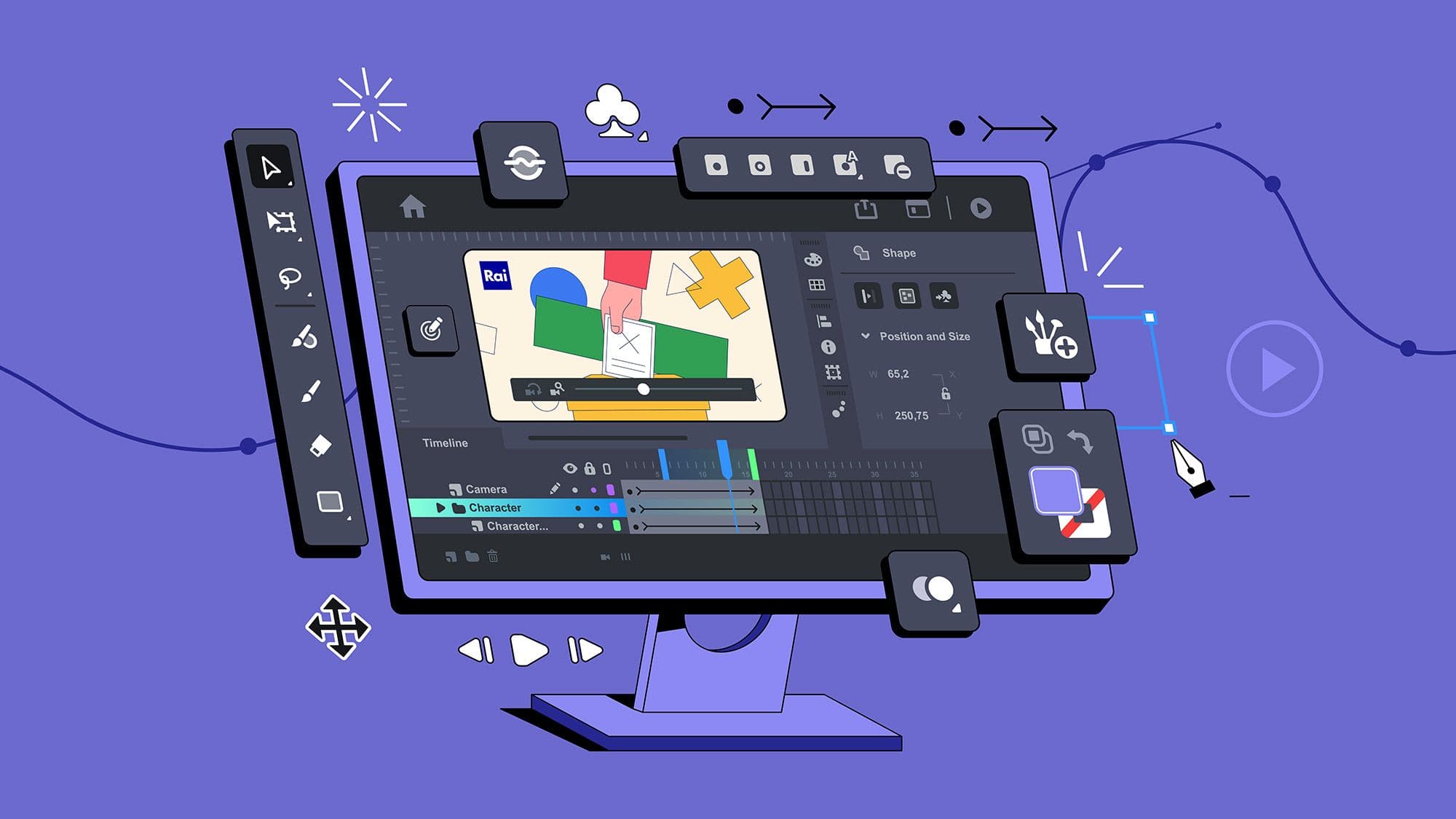
TV advertising: when motion graphics make a commercial or video campaign more effective
When people talk about television advertising, they often think of filming, actors, voiceovers, and editing. Yet, a significant part of the effectiveness of many commercials also comes from motion graphics: titles, packshots, supers, transitions, data visualization, and campaign end-boards—elements that guide the eye and reinforce memorability. This is even truer today, because a TV spot rarely lives only on television: it continues online, is cut into short formats, adapted for vertical video, or used in silent versions.
When motion graphics really make the difference
It should be viewed not as a technical addition, but as a layer of design. In a well-constructed spot, motion graphics intervene to direct attention, clarify a promise, reinforce brand memory, and prepare the video for its future adaptations.
Motion graphics do not always serve the same purpose. In some commercials, they have an almost invisible function: helping to order the message, clarify an offer, or make the brand more recognizable. In others, they become a central component of the creative language. Thinkbox analyses on TV formats and memory show that the construction of a spot—including the duration and clarity of its visual components—impacts the content's ability to stick.
- when dealing with topics that are difficult to represent through filming;
- when there is a need to stand out;
- when an offer or benefit needs to be explained more clearly;
- when brand presence needs to be reinforced without interrupting the narrative;
- when the spot must be adapted to different formats after airing;
- when the message must work even in snippets, cutdowns, and digital versions.
It is not, therefore, about adding movement "for show." It is about designing elements that make the video more readable, richer in brand signals, and easier to reuse in subsequent stages of the campaign.
TV, online video, and campaign continuity
This transition is decisive because today, no spot remains confined to the medium for which it was initially intended. Every strong video is cut, adapted, distributed, and recontextualized. Motion graphics, if intelligently designed, are what hold these transformations together.
One of the most interesting points is precisely this: motion graphics help the television spot move beyond its original perimeter. Think with Google reflections on video creative experiments show how much the format and viewing context change audience behavior. A video campaign today works best when it is born already thinking about how it will be cut, readapted, and redistributed.
- creating visual continuity between the long spot and short formats;
- maintaining recognizability even when duration and channel change;
- helping to make individual campaign snippets autonomous;
- supporting the message even when the narrative component is compressed.
Halfway between a spot and a campaign, the useful question is this: will the video you are producing hold up outside its main version? Studio Polpo can help you design motion graphics that make a spot clearer and stronger on TV, but also more adaptable when it enters a broader video campaign.
Use cases: three situations where it works very well
The instances where motion graphics make a difference are much more numerous than it seems. They usually emerge when the spot must sustain multiple lives simultaneously: television, digital, commercial, and reuse within campaign materials.
- retail or promotional spots, where offers, timings, conditions, and calls to action must be readable without weighing down the edit;
- brand campaigns, where titles, end-boards, and visual cues help provide coherence to multiple subjects or different cuts of the same story;
- product or service videos, where data, functionality, or benefits require clearer visualization.
What makes the result truly effective
Effectiveness, in this case, does not depend on the quantity of movement or the number of graphic elements on screen. It depends on their precision. Good motion graphics enter the film naturally, reinforce the brand promise, and provide continuity between the main spot, short cuts, and derivative formats.
System1 analyses on creative effectiveness remind us that the quality of an advertisement does not depend on a single formula, but on the ability to produce a memorable response consistent with the category and the brand. For motion graphics, this means one simple thing: they must enter the spot as part of the story, not as an alien superstructure. Thinkbox insights on the relationship between TV creativity and memory go in the same direction: what is remembered best is what builds a coherent visual and narrative trail.
- respecting the rhythm of the spot instead of interrupting it;
- using recognizable brand marks without overloading the frame;
- making the content more readable, not noisier;
- being designed with future campaign adaptations already in mind.
Common mistakes
Mistakes become evident especially when graphics are treated as a last-minute finish. If they do not enter the project early enough, they risk being added "on top" of the story rather than becoming an organic part of it.
- adding graphic elements too late, when the spot is already locked;
- using text or animations that work only on the main film and not in adaptations;
- overloading the final seconds with too much information;
- considering graphics as an embellishment rather than part of the video strategy.
Today, a spot no longer lives in one place. It lives on TV, in catch-up (on-demand), on social media, in pre-roll (online video ads before other content), on landing pages, and in vertical formats. The more the video is distributed, the more the value of a well-thought-out graphic structure increases. In this sense, motion graphics are not a technical detail: they are a lever that holds together clarity, adaptability, and brand continuity. If you are working on a spot or a video campaign and want the content to remain strong even when it changes format, Studio Polpo can help you build motion graphics that truly improve the project's performance: on TV, online, and in all the video materials that follow.
For this reason, the most useful motion graphics are not the ones noticed the most, but those that allow the video to continue functioning when it is shortened, cropped, republished, or seen outside its original context. In a contemporary campaign, the longevity of a spot also depends on the quality of its visual infrastructure.
FAQ
Are motion graphics only useful for promotional spots?
No. They can also be useful in brand spots, helping to make the narrative more recognizable or coherent.
Do they risk making the spot too cluttered?
Only if used without criteria. When designed well, they increase clarity and memory without adding weight.
Should they be considered at the beginning of production?
Yes. They are much more effective when they enter the project from the concept stage and not as a last-minute fix.