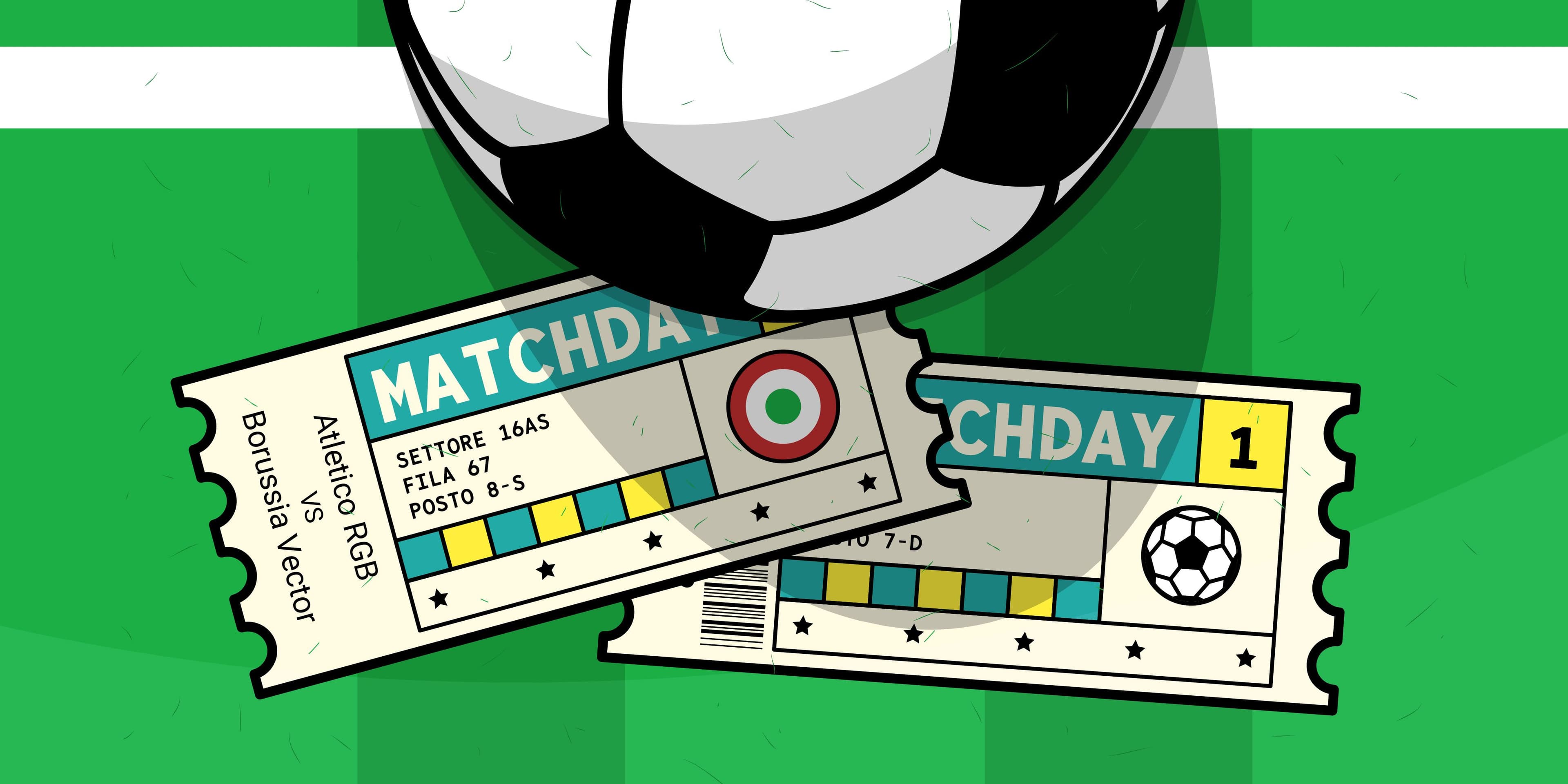
Matchday graphics for football teams: how social media content transforms matches into visual narratives.
Matchday graphics are the visual contents published by football teams to announce, accompany, or recount a match. For a long time, they were primarily informational posts: opponent, date, time, stadium, and competition. Today, however, many clubs are transforming them into small visual stories, built with increasingly recognizable and creative graphic languages.
The change is evident: it is no longer just about communicating that a game will be played, but about building an image capable of synthesizing tone, opponent, context, footballing memory, and club identity. A matchday graphic can reference a location, a film, a local product, a rivalry, a page of sporting history, or a popular reference linked to the city of the opposing team.
Creative Review, in an article dedicated to the role of design in modern clubs, observes that football clubs are now global brands with international audiences, but they must continue to maintain a link with history, identity, and the local fan base. This balance between a global dimension and local belonging is one of the reasons why sporting graphics can no longer be limited to a generic template: they must hold together digital communication, recognizability, and club culture.
What matchday graphics are
Matchday graphics are visual contents designed for the day of the match, or for the days leading up to it. They can announce the match, present the lineups, share statistics, celebrate a result, accompany the live coverage, or create anticipation around the event.
They usually include:
- name of the teams;
- date and time;
- stadium or competition;
- official logos and colors;
- player images;
- visual references to the match;
- narrative, ironic, or cultural elements.
The difference compared to the past lies in the way these elements are treated. Graphics no longer serve just to order information, but to build a small piece of editorial content. A match becomes an opportunity to tell something: an atmosphere, a city, a historical precedent, a shared imagery.
For this reason, matchday graphics are not simple digital posters. They are a part of the team's communication and contribute to defining how the club presents itself every week.
From informational posts to visual storytelling
The most interesting transition is that from functional posts to visual storytelling. The match remains the center of the content, but it is interpreted through a specific graphic direction. Every match can become a theme, a reference, a cultural game, or an opportunity to dialogue with fans.
This type of content can include:
- references to the opponent's city;
- cinematic or musical quotes;
- gastronomic, historical, or popular imagery;
- nostalgic elements linked to footballing memory;
- typographic play;
- graphic languages taken from posters, covers, video games, advertisements, or sporting archives.
A pertinent example comes from the official channels of AS Roma, where matchday graphics are often treated as small digital posters, varying from game to game. In the content dedicated to challenges against Parma and Milan, for instance, the club uses very different registers: gastronomic references linked to Parma, nostalgic objects like VHS tapes, or the language of theater posters to play on the idea of the "Scala del calcio." The variety of languages shows how much this type of content can move between sports posters, visual quotes, editorial graphics, and ironic storytelling, while remaining within the club's identity.
This evolution makes the content more shareable. The fan does not just receive information: they recognize an idea, a reference, a visual joke, or an identity trait. This is where the matchday becomes cultural communication, not just service communication.
This logic, moreover, is not confined to social media: AS Roma also has an official section dedicated to Matchday T-shirts, where graphics linked to the matches are transformed into t-shirts fans can buy. The visual content thus also becomes a product, a memory of the event, and a further opportunity for the relationship between the club and the public.
Why they work on social media
Football teams communicate in a very particular context. The audience is already emotionally involved but receives an enormous amount of content: highlights and videos, conferences, statistics, news, player content, sponsors, results, and comments. In this flow, weak graphics risk disappearing.
A good matchday graphic works because:
- it captures attention in a few seconds;
- it makes the club recognizable in the feed;
- it creates anticipation before the match;
- it offers content that is easy to share;
- it allows communication even with those who won't read a press release or an article;
- it strengthens the team's tone and personality.
Content Stadium, in an article dedicated to social strategies for football, highlights how clubs can use personalized content to increase engagement, reach, and recognizability. Among the examples, it cites content linked to the matchday, player content, and branded formats that is, consistent with the visual identity of the club or the sponsor.
Matchday graphics have become so important because they are rapid, recurring, emotional, and recognizable content. They do not live in isolation but within a continuous conversation between the club and the fans.
Visual identity and club tone
Every team has a history, a city, a fan base, colors, symbols, and a way of telling its own story. Matchday graphics can strengthen all of this, but only if they are not designed as generic content.
A good visual direction must ask:
- what is the tone of the club;
- which elements of its identity are truly recognizable;
- how much space to give to irony, nostalgia, or sporting aggression;
- how to use colors and typography without betraying the brand;
- how to vary from match to match without losing consistency.
This balance is delicate. If every post is too different from the others, the team loses recognizability. If every post is too similar, communication becomes repetitive. The design work lies precisely in building a system capable of varying without fragmenting.
In this sense, matchday graphics are an interesting testing ground for a team's visual identity: they must be immediate, but also consistent; creative, but recognizable; linked to the individual match, but part of an entire season.
The role of art direction
In the most successful matchday graphics, the difference is often made by art direction. It is not enough to choose a photo of the player, add logos, and write the time. A visual idea is needed that can hold together content, style, tone, and context.
Art direction helps define:
- the concept of the individual match;
- the type of visual reference to be used;
- the hierarchy between information and storytelling;
- the relationship between club identity and the opponent;
- the level of irony or quotation;
- continuity with the rest of the season.
Behind Sport, in a selection dedicated to the best matchday graphic packages of European leagues, shows very different approaches: retro, minimal, editorial, futuristic, illustrated, photographic, or strongly typographic. The selection looks not only at individual posts but at entire seasonal visual systems.
A single graphic can work, but a system works better. It allows the team to build a recognizable visual voice match after match.
Between templates and custom content
Many sports organizations use templates—predefined graphic models—to speed up production. It is understandable: during a season, there is a lot of content to publish, often with tight deadlines. The problem arises when the template becomes the only possible language.
A system that is too rigid risks producing:
- posts that all look the same;
- little attention to the context of the match;
- lower fan engagement;
- content that is easy to confuse with that of other clubs;
- communication that is orderly but not very memorable.
This does not mean templates should be eliminated. On the contrary, they can be useful if they are part of a broader system. The best solution is often a balance: solid graphic foundations for recurring content and more characterized projects for special matches, derbies, cups, historical rivalries, or moments with high communication value.
If a team wants to raise the quality of its communication, it doesn't necessarily have to reinvent everything every week. It must, however, build a language flexible enough to transform some matches into stronger content.
Why sponsors and partners are also interested
Matchday graphics do not only speak to fans. They also speak to sponsors, partners, media, and potential collaborators. A club with polished visual communication conveys professionalism, attention to detail, and the ability to enhance its content.
This can have concrete effects:
- it increases the perceived quality of the club;
- it makes sponsored content more interesting;
- it creates formats better suited for sharing;
- it improves the team's recognizability;
- it gives more value to the club's digital assets.
Content Stadium, in an article dedicated to social strategies for football, emphasizes how clubs can use personalized content consistent with the brand to increase social media presence while maintaining control over their image. The same source cites examples of personalized matchday content for players, which is then shared on their channels as well.
Sporting graphics are not just about aesthetics. They are also a way to expand the circulation of content and make the team's communication ecosystem stronger.
Most frequent errors
Many matchday graphics are weak not because they lack information, but because they lack an idea. They are correct, readable, perhaps even well-laid out, but they don't build any narrative.
The most frequent errors are:
- using the same scheme always without significant variations;
- confusing creativity with an accumulation of effects;
- inserting cultural references that are unclear or forced;
- losing consistency with colors, tone, and club identity;
- sacrificing legibility and essential information;
- thinking about the individual post without considering the season as a whole.
The point is not to make every piece of content spectacular. It is to give every piece of content a precise function.
Conclusion
Matchday graphics for football teams are becoming much more than simple informational posts. They are recurring, recognizable visual contents capable of transforming every match into a small story: a quote, a local reference, a sporting memory, a graphic game, or a sign of the club's identity.
When they are well-designed, they help a team stand out in the social media flow, strengthen the relationship with fans, and present themselves more professionally even toward sponsors and partners.
If you want to build a system of matchday graphics that is more recognizable, creative, and consistent with your team's identity, Studio Polpo can help you transform the sporting calendar into a series of visual contents that are stronger, more memorable, and more shareable.
FAQ
What are matchday graphics?
They are visual contents published by teams and sports clubs to announce or recount a match. They can communicate the date, time, and opponent, but also build a visual concept (guiding idea) linked to the match.
Why are matchday graphics important on social media?
Because they help the club be recognizable, create anticipation, engage fans, and stand out in a continuous flow of sporting content.
Does a matchday graphic always have to be different from game to game?
Not necessarily. A consistent system is needed, but one that is flexible enough to allow for variations, quotes, and specific ideas for the most relevant matches.