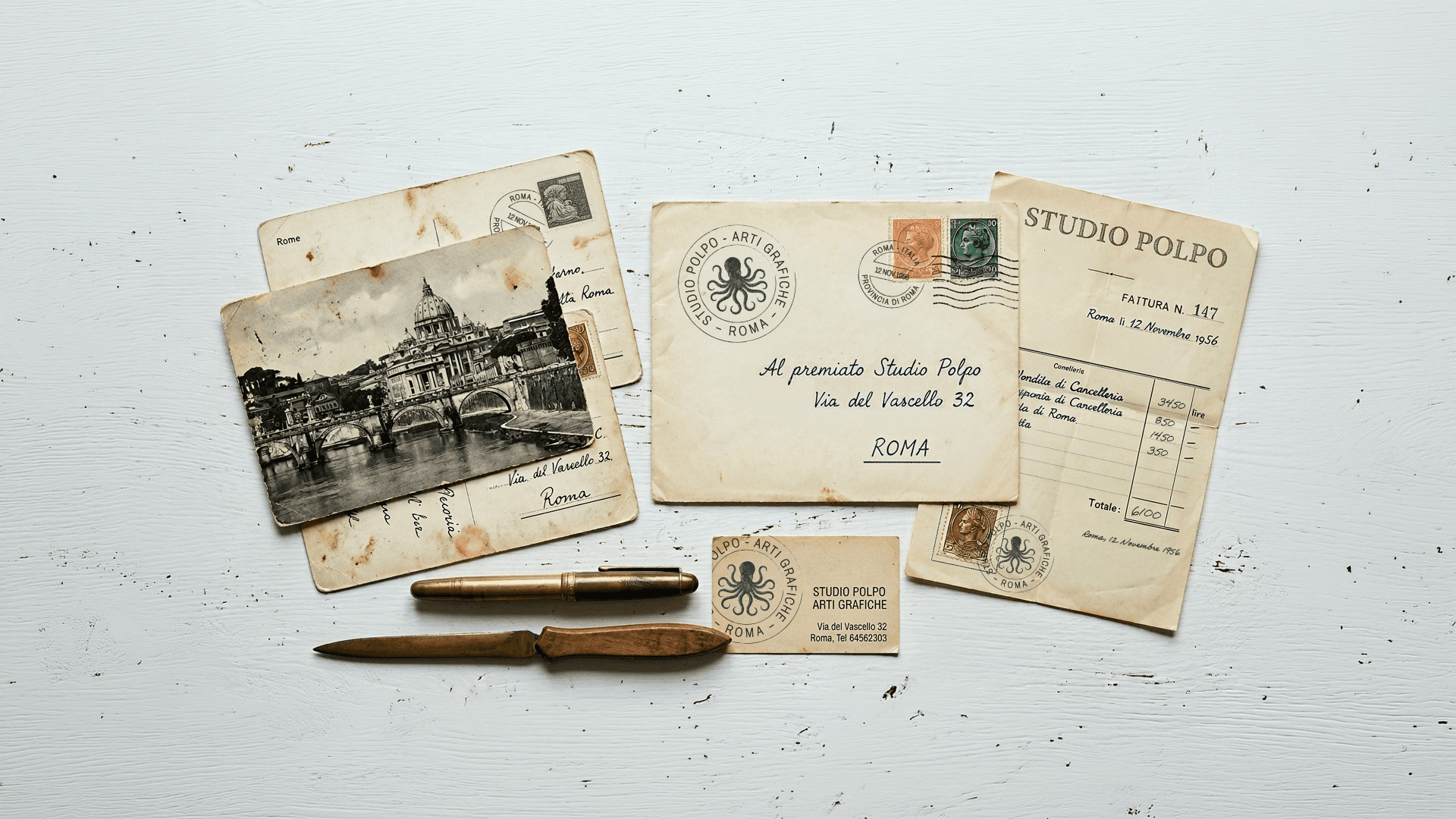
Graphic props for film: why hiring a graphic design studio improves a movie’s quality and credibility
Graphic props for movie are one of the most discreet yet decisive elements in the visual construction of a movie. Documents, signs, interfaces, printed and digital objects all contribute to defining the narrative world, even when they are not the focus of the shot.
The difference between a solid project and a weak one lies not only in aesthetic quality but in the ability to build coherence. For this reason, relying on a specialized graphic design studio is not an optional choice, but a design lever that directly affects the film's credibility.
In an in-depth piece published by Creative Review on graphic design for filmmaking, it is highlighted how the graphic department in cinema must contribute to building the narrative world through objects designed to look authentic both on set and in close-up shots.
Why rely on a graphic design studio
Entrusting graphic props to a specialized studio means introducing method, consistency, and control into the process. It is not just about "producing materials," but about building a visual system capable of holding the frame and supporting the narrative.
In concrete terms, a graphic studio works on:
- visual coherence among all scene elements;
- typographic and design quality;
- adaptation to filming and production constraints;
- control of details, even the least visible ones.
The point is not merely executive. It is strategic: graphic props must be conceived as part of the film's visual system, not as isolated elements. This aspect also emerges in the article "So You Wanna Design for the Movies?" published by AIGA Eye on Design, where the work of graphic prop designers is described as a practice requiring extreme attention to the plausibility of objects and their integration into the cinematic story.
The importance of the research and design phase
One of the most relevant aspects is the research and design phase. Graphic props cannot be generic: they must be consistent with the historical, social, and cultural context in which the story is set.
This means working on:
- real visual references (era, country, institutions);
- typographic languages consistent with the period;
- plausible materials and formats;
- credible content (names, texts, information).
A document set in the 1970s, for example, cannot use 1990s fonts or contemporary design languages without creating a visual fracture. The design process serves precisely to avoid these inconsistencies.
This phase is not accessory: it is what allows props to appear credible even when observed closely and to integrate naturally with the rest of the scene.
Coherence and credibility: the true value of props
The value of graphic props lies not in their visibility, but in their ability to sustain the credibility of the narrative.
A well-designed graphic system:
- strengthens the film's visual identity;
- prevents inconsistencies between scenes and environments;
- supports the direction in close-up details;
- contributes to the construction of the narrative world.
In the essay "Production Design and the Creation of Story Worlds", published by the academic journal Kosmorama, it is explained how cinematic design elements serve to create believable worlds in which action and story can exist coherently. Graphic props are part of this visual construction process.
Why improvisation doesn't work
One of the most common mistakes is treating graphic props as secondary elements, to be solved quickly or with generic solutions.
This approach often leads to:
- the use of materials inconsistent with the context;
- incongruities between elements of the same scene;
- loss of visual identity;
- difficulties during filming, especially regarding details.
The problem is not just aesthetic. It is structural. When props are not properly designed, the film loses coherence and credibility. Conversely, a design-led approach allows for the creation of elements that truly work within the context of the scene and withstand even close scrutiny.
Integration with production and direction
Another advantage of working with a studio is the ability to integrate with other departments. Graphic props must dialogue with production design, costumes, cinematography, and direction.
This means:
- adapting to framing requirements;
- coordinating with palettes and materials;
- meeting production deadlines;
- ensuring continuity between different scenes.
If you are working on a film, a series, or an audiovisual project, involving a graphic design studio from the early stages allows you to avoid weak solutions and build a more solid visual system. Studio Polpo can help you design graphic props that are coherent, credible, and perfectly integrated into the project.
Design challenges in graphic props
Problems with graphic props can stem from technical errors, but more often the cause is a lack of integration in the process.
The most significant issues emerge when:
- graphics are developed too late in relation to production;
- there is a lack of coordination with production design and art direction;
- materials are adapted rather than designed;
- no unified vision exists among the various scene elements.
In these cases, even formally correct graphics risk appearing incoherent. The problem is not the individual element, but the absence of a system.
Conclusion
Graphic props for cinema are not a secondary detail, but an essential component of visual construction. Relying on a graphic design studio means working on coherence, quality, and credibility, avoiding improvised solutions.
The difference is seen in the details but felt in the whole. That is where a project becomes truly solid. If you want to develop graphic props, scene documents, or visual systems consistent with your project, Studio Polpo can help you build a result that is more credible, more precise, and more effective.
FAQ
What is the relationship between graphic props and production design?
Graphic props are, for all intents and purposes, part of the production design. They contribute to defining environments, contexts, and visual information that make the space believable.
Does a graphic studio work independently or with the production?
It works in close collaboration with production, direction, and art direction. Props must respond to narrative and technical needs, not just aesthetic ones.
How much do graphic props affect the audience's perception?
They affect it indirectly but decisively. When they are coherent, they strengthen the film's credibility. When they are not, they become distracting elements, even if they are marginal.