Graphic props for film: what they are, what they are for, and why they are fundamental
Graphic props for film are all those visual elements designed to be used on set: documents, newspapers, labels, packaging, signs, photographs, maps, and any other graphic artifact that appears within the frame. Even when they occupy only a few seconds of screen time, they contribute directly to the construction of the narrative world.
Their role is often underestimated because they act silently. They do not necessarily draw attention, but they make what is seen credible. When they work, the viewer very often does not notice them. When they do not work, they immediately break the suspension of disbelief.
This aspect is also well explained by Annie Atkins, a graphic designer for cinema who has worked on films such as The Grand Budapest Hotel. In her talk for Creative Mornings, she describes graphic props as elements that "must look real even when no one is really looking at them." It is an effective summary of their role: building reality without declaring itself.
The same principle emerges in an interview published by It’s Nice That, where Annie Atkins explains how working on graphic props consists of designing objects that have a credible internal logic, even when they are not directly read by the viewer. This approach reinforces the idea that scene graphics do not serve to decorate, but to support the coherence of the narrative world.
What graphic props are
In a cinematic context, graphic props are a specific category of stage props: all those elements that require a visual and typographic design to exist credibly in front of the camera.
They can include:
- official documents, letters, passports, files;
- newspapers, magazines, books, and editorial materials;
- signs, signage, posters;
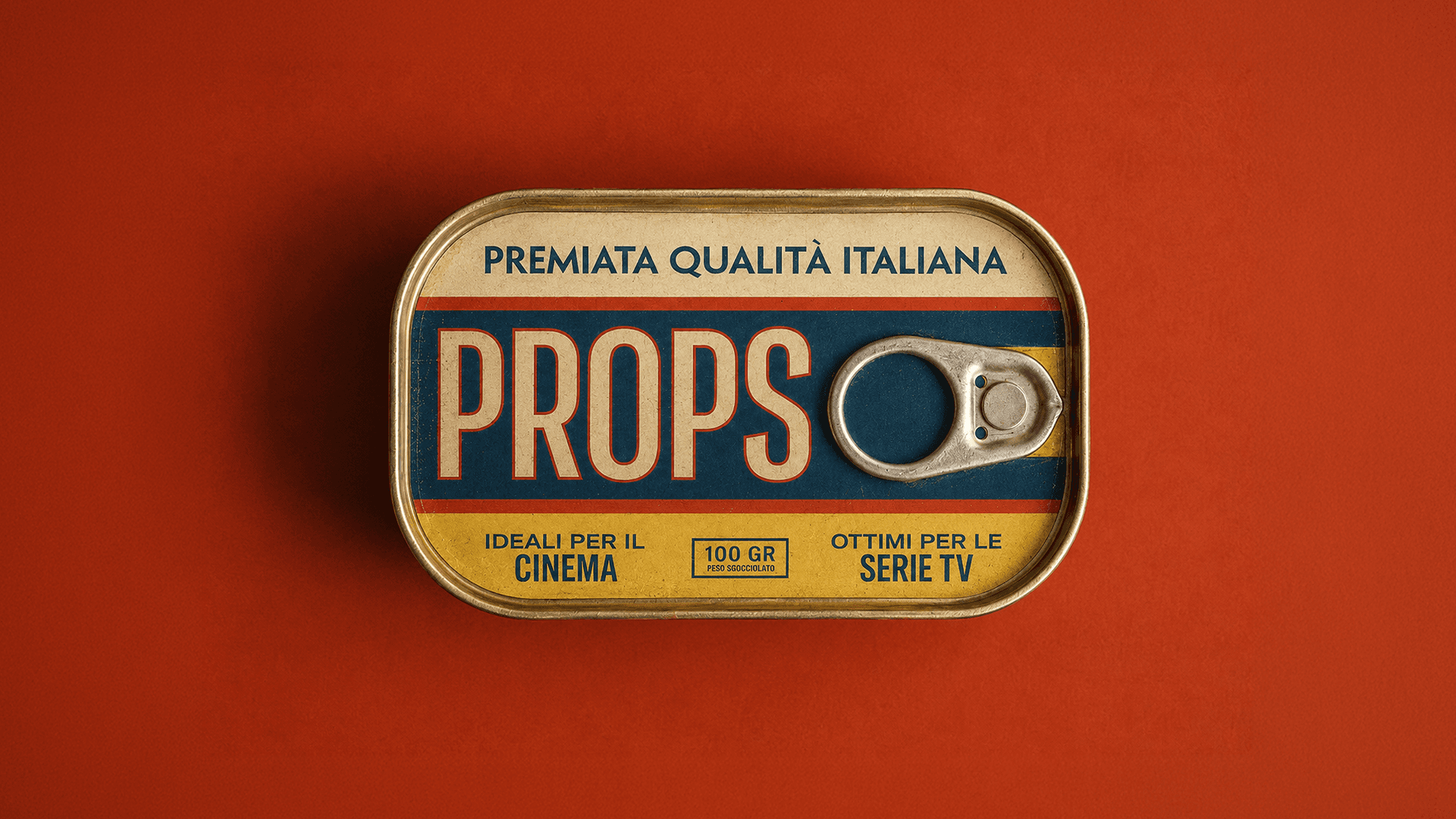
- labels, packaging, and products;
- digital interfaces, screens, notifications;
- maps, diagrams, and information materials.
Unlike other scenic objects, these elements cannot simply be found or adapted. They must be designed. They require typographic consistency, attention to detail, knowledge of visual references, and the ability to adapt to filming requirements.
Within the context of film production, the work of graphic designers falls squarely within production design and contributes to the overall art direction of the film. This clarifies that graphic props are not an accessory addition, but an integral part of the art department.
What they are used for, in practice
Graphic props for film serve to make the narrative and visual world of the film readable and credible. Even when they are not at the center of the action, they work on multiple levels simultaneously.
In particular, they:
- give consistency to the narrative context;
- help define the era, place, and environment;
- make actions and information on scene plausible;
- support the direction when the shot moves in on details;
- contribute to visual continuity between scenes.
A document, a label, or a sign is never a neutral element. If designed well, they strengthen the narrative. If designed poorly, they create visual inconsistencies that are hard to ignore, especially in close-up shots or in high definition.
Graphic design applied to cinema is effective when it succeeds in building context without requiring explicit attention—that is, when it works as an invisible but structural part of the visual experience.
Why they are fundamental in visual construction
The strength of graphic props lies in their ability to make a world that is, by its nature, constructed, feel concrete and plausible. Cinema always needs elements that transform abstraction into credible visual reality.
This is even more true today for at least three reasons:
- high-definition filming makes even the smallest details visible;
- content is reviewed, paused, and analyzed frame by frame;
- audiences are increasingly accustomed to recognizing visual inconsistencies.
In this context, graphic props become a structural element. They don't just serve to "fill" the scene, but to support it. Credible graphics allow the viewer to stay inside the film without distractions.
If you are working on a film project, a series, or an audiovisual production, considering graphic props from the early stages can make a significant difference. Studio Polpo can help you design visual elements that are coherent, credible, and perfectly integrated with production design and direction.
The most frequent mistakes
Many problems related to graphic props do not stem from a lack of tools, but from a superficial or late approach to design.
The most common are:
- using generic or stock materials without adaptation;
- neglecting typographic and stylistic coherence;
- designing without considering distance and filming methods;
- inserting information inconsistent with the narrative context;
- thinking of props as secondary and peripheral elements.
A recurring error is also designing visual elements that are correct from a graphic point of view, but not from a narrative one. A document can be well-laid out and still appear fake if it does not respect the historical, geographical, or institutional context in which it is placed.
Conclusion
Graphic props for film are one of the most discreet yet effective tools in the visual construction of a movie. When designed with care, they reinforce visual credibility, support the narrative, and help create a coherent world.
If you want to work on graphic props, scene documents, or visual elements designed for the camera, Studio Polpo can help you build a system that is coherent, readable, and perfectly integrated with the film project.
FAQ
Are graphic props only useful in complex or high-budget films?
No. Even in simpler productions, the quality of visual details affects overall credibility. Graphic props are useful in any audiovisual project.
When should graphic props be designed?
Ideally during the initial stages of production. Anticipating these choices allows for more coherent work with production design, direction, and cinematography.
Must graphic props always be legible on camera?
Not always completely, but they must be consistent and credible even when they are in focus or observed closely. Their visual solidity must hold up in any type of shot.